Freedom in the Arts Parliamentary Launch
Churchill Room, Palace of Westminster
27 April 2026
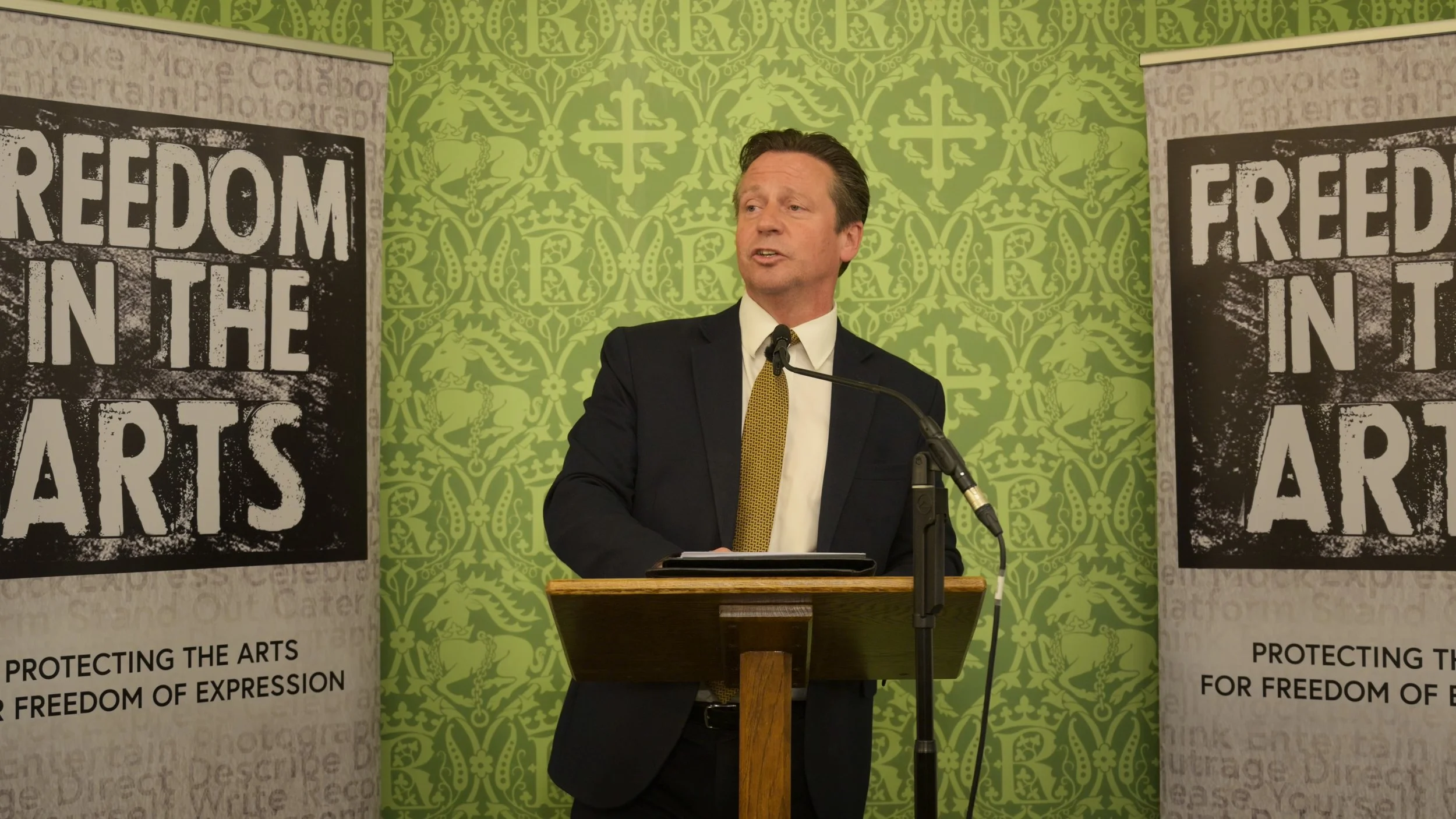
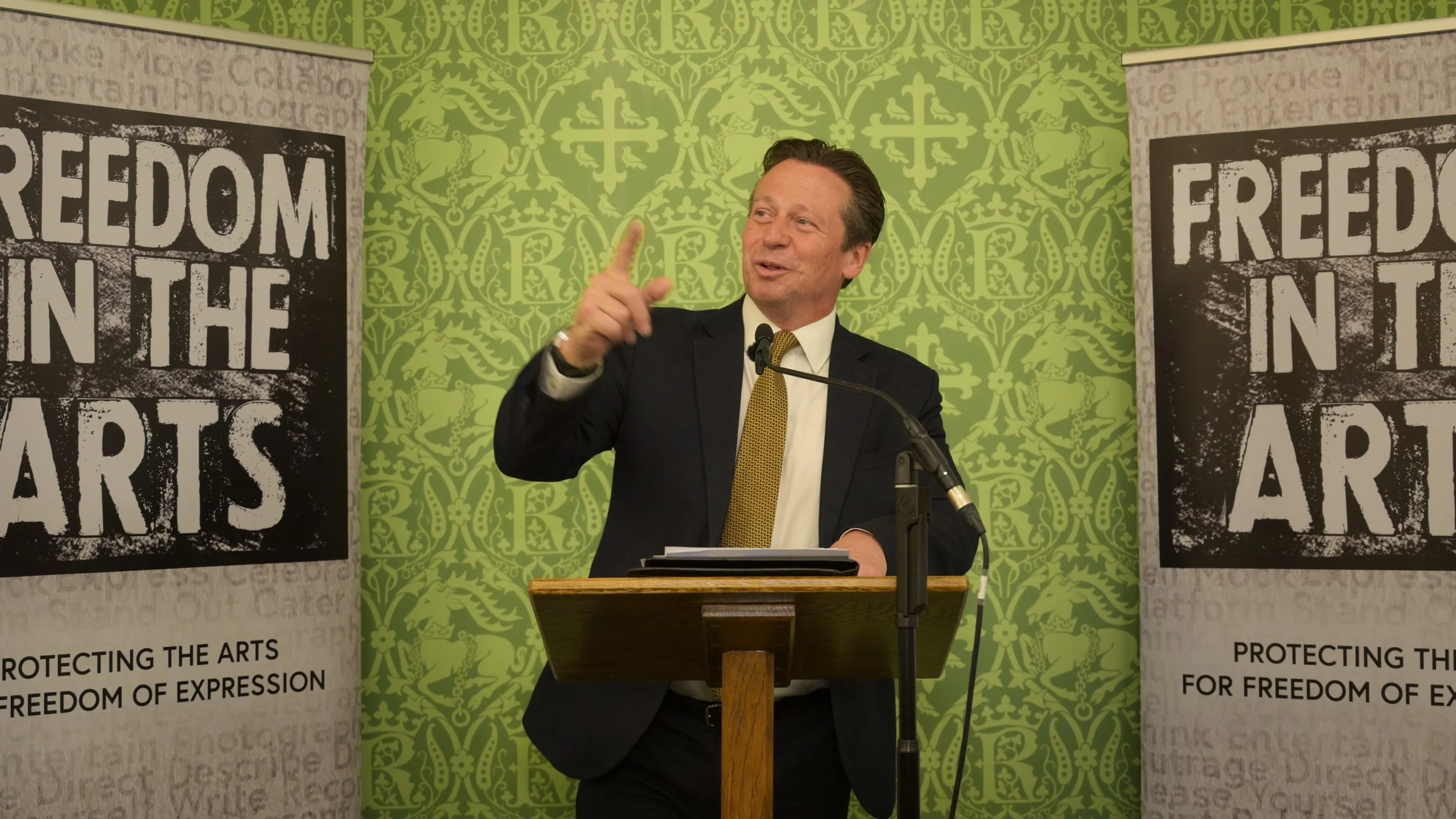
Nigel Huddleston MP at the Freedom in the Arts parliamentary launch
At the parliamentary launch of The New Boycott Crisis and the Art Beyond Boycott Toolkit, Nigel Huddleston MP opened the evening by framing freedom of expression in the arts as a matter of democratic importance, and by urging serious attention to the report’s findings on boycott pressure and antisemitism in the cultural sector.
Short biography
Nigel Huddleston MP is the Member of Parliament for Mid Worcestershire and Shadow Secretary of State for Culture, Media and Sport. He previously served in government in senior roles across DCMS, including as Minister for Sport, Tourism, Heritage and Civil Society, and has been a prominent voice on the importance of cultural life, public institutions and freedom of expression.
Churchill Room, Palace of Westminster, 27 April 2026
Nigel Huddleston MP hosted the parliamentary launch of Freedom in the Arts’ new report, The New Boycott Crisis, and the accompanying Art Beyond Boycott Toolkit. In his opening remarks, he set the political frame for the evening, arguing that when freedom of expression in the arts is narrowed by fear, intimidation or organised pressure, the issue is not only cultural but democratic.
Link to the Full Speech HERE
Good evening, everyone, and welcome.
It is a real pleasure to join you here in Parliament for the launch of Freedom in the Arts’ new report, The New Boycott Crisis, and the accompanying Art Beyond Boycott Toolkit.
Thank you all for being here, and thank you in particular to Rosie Kay, Denise Fahmy and Professor Jo Phoenix, authors of The New Boycott Crisis.
This report is an important and timely contribution to a debate that has too often been conducted in fragments; through noisy rows and media headlines. The report brings evidence and structure to something many people in the sector have felt for some time: that pressure, fear and organised intimidation are beginning to shape the conditions in which art is made.
The New Boycott Crisis exposes how pressure and boycott movements are devastating the arts; we are seeing cancellation, professional exclusion, harassment and compelled political positioning.
And sadly this is not simply a matter of a few isolated controversies, or the occasional disagreement that inevitably comes with a lively artistic culture.
The report highlights what the authors call “boycott logic” has created an interconnected pattern of pressure, reshaping what artists, venues and organisations feel able to create, present and discuss. And that should concern us all.
The arts are not some optional extra in national life. The arts are where a society imagines, questions, remembers and argues with itself.
It is where freedom of thought becomes a living and public experience. Freedom of expression is not peripheral to democracy. It is part of its texture and one of its tests.
In any healthy democracy, the arts should be places of experimentation, disagreement, curiosity and risk. They should not become places where people are forced into silence by fear, reputational intimidation or organised campaigns.
And yet that is precisely the concern The New Boycott Crisis raises.
The report describes a climate in which many artists, particularly freelancers dependent on reputation and networks of goodwill, are finding opportunities disappearing not because of the quality of their work, but because of who they are, what they are assumed to believe, or the controversy others fear may follow.
Venues and festivals increasingly make decisions not in response to actual protest, but in anticipation of what might happen, often under internal staff pressure rather than audience demand.
This is the notion of anticipatory compliance. Where the damage is often done before any public campaign even gets going. Where he possibility of backlash becomes enough to shape decisions. And each act of compliance makes the next one easier.
That matters not only for the arts, but for public life more broadly.
When freedom of expression in the arts is narrowed by fear, intimidation or organised pressure, that is not only a cultural concern. It is a democratic one.
The arts should challenge and question and push boundaries. But there is a world of difference between pushing boundaries, having a respectful and informed, robust debate; and intimidation or cancellation; or worse: promulgating hatred.
Pushing extreme views and cancelling out others is NOT NORMAL, it is EXTREMIST behaviour and is inconsistent with core British values. Core Conservative values, if I may, of freedom, democracy, tolerance, genuine inclusivity, responsibility, and respect – for each other and for law and order.
But it never ceases to amaze me how so many people who go around lecturing everyone else about diversity and preaching tolerance, lack the self-awareness to recognise that they themselves are the worst offenders, and amongst the least tolerant kind of people around.
Because they don’t actually believe in freedom and tolerance, they cannot accept anyone with a different opinion to them, and what they really want is for everyone else to think just like them. And if you don’t, you are somehow malevolent.
And that brings me to one of the most serious findings of The New Boycott Crisis report.
The report is clear that antisemitism is not incidental — it is one of the most troubling features of this boycott logic.
The evidence gathered suggests that Jewish and Israeli artists are disproportionately affected by organised pressure, and that Jewish artists are too often subjected to exceptional scrutiny, exclusion or suspicion. Jewish artists and Jewish cultural life become treated as uniquely contentious, uniquely risky, or somehow inherently political. That should trouble all of us.
Where Jewish cultural life is treated as inherently problematic, or where Jewish identity itself becomes a trigger for pressure and distrust, that should concern anyone who values fairness, democracy and the integrity of our public culture.
Of course, this is not about endorsing every work or every point of view. None of us agree with every point, every view, every piece of art or expression performed by everyone in this room this evening.
But it is about whether our arts sector remains a place where disagreement can exist without coercion and intimidation, and where institutions have the confidence to act lawfully, proportionately and fairly.
That is why the second part of tonight’s launch matters just as much as the first.
Because alongside the report, Freedom in the Arts is also launching the Art Beyond Boycott Toolkit. This is a practical response to boycott pressure. It provides clear guidance, step-by-step tools, templates and checklists. It recognises both lawful protest and artistic independence. It is not just diagnosing a problem. It is helping the sector respond to it.
And government and politicians have a role here, too.
Democratic institutions should not be indifferent when fear begins to shape public culture. Parliament is exactly the right place to have this debate. The concerns raised by this report deserve serious engagement from ministers, officials, politicians and all those responsible for the health of our cultural institutions. Especially those that are publicly funded or lottery funded.
The debate is timely. We, the Conservatives, are conducting our own policy review, and this report will input into that. We are considering the role, purpose, remit and distribution criteria for lottery funding bodies. And we are of course in a live debate about the funding and scope of the BBC and how it abides by its impartiality obligations. And if you will allow me to go off on a slight tangent here, may I remind you, the BBCs own editorial guidelines clearly state that:
“Audiences expect the BBC… to meet the highest levels of impartiality and accuracy.”
I couldn’t agree more…
The editorial guidelines also make clear that:
“There is no requirement to give all views equal weight... Minority views or those less supported by evidence, do not need to be given similar prominence or weight to those with more support, to the prevailing consensus, or to those better evidenced.”
Which begs the question why the BBC cannot bring itself to call Hamas a terrorist organisation, for example.
Or why it felt obliged to reprimand a journalist (Martine Croxall) for saying ‘women’ instead of ‘pregnant people’ live on air.
Impartiality should not be used as an excuse to push minority or woke views that are not supported by the majority of the British population. Moreover, in this case, I believe that the breech of impartiality rules was not Martine Croxall’s unscripted comment, but the editor or writer who put the words ‘pregnant people’ in her script in the first place. This speaks volumes about the extent to which impartiality is being misinterpreted within the BBC. But they are not the only ones, and I didn’t come here this evening just to take the opportunity to bash the BBC.
Before I finish, I’d like to highlight that we have a remarkable group of people with us this evening, each bringing a different perspective on the problem. Rosie Kay, as co-director of Freedom in the Arts and one of the authors of the report, will introduce the other speakers and guide us through the evening in a moment. And I hope all of you will take the opportunity this evening to introduce yourselves and continue the conversation with our guests.
Tonight is important for many reasons because we are discussing real life experiences, evidence and principles. Most of all it is recognising that artistic freedom is not a luxury. It is one of the conditions of a confident and truly free society.
I want again to thank Freedom in the Arts for the work they have done in bringing this report and toolkit forward, and for the support they have already provided to artists and organisations under pressure. This is work of real public value.
And it now gives me great pleasure to invite Rosie Kay, co-director of Freedom in the Arts and co-author of the report, to speak about the work that has brought us here this evening.